Mosaic floors
Stone tesserae outlast the walls that stood above them — and say more about a room than any inscription.
- Entry
- B.4
- Where
- Butrint, Durrës, Apollonia
- Period
- Hellenistic to late antique
- Section
- The Ancient Shore
01Why the floor survives
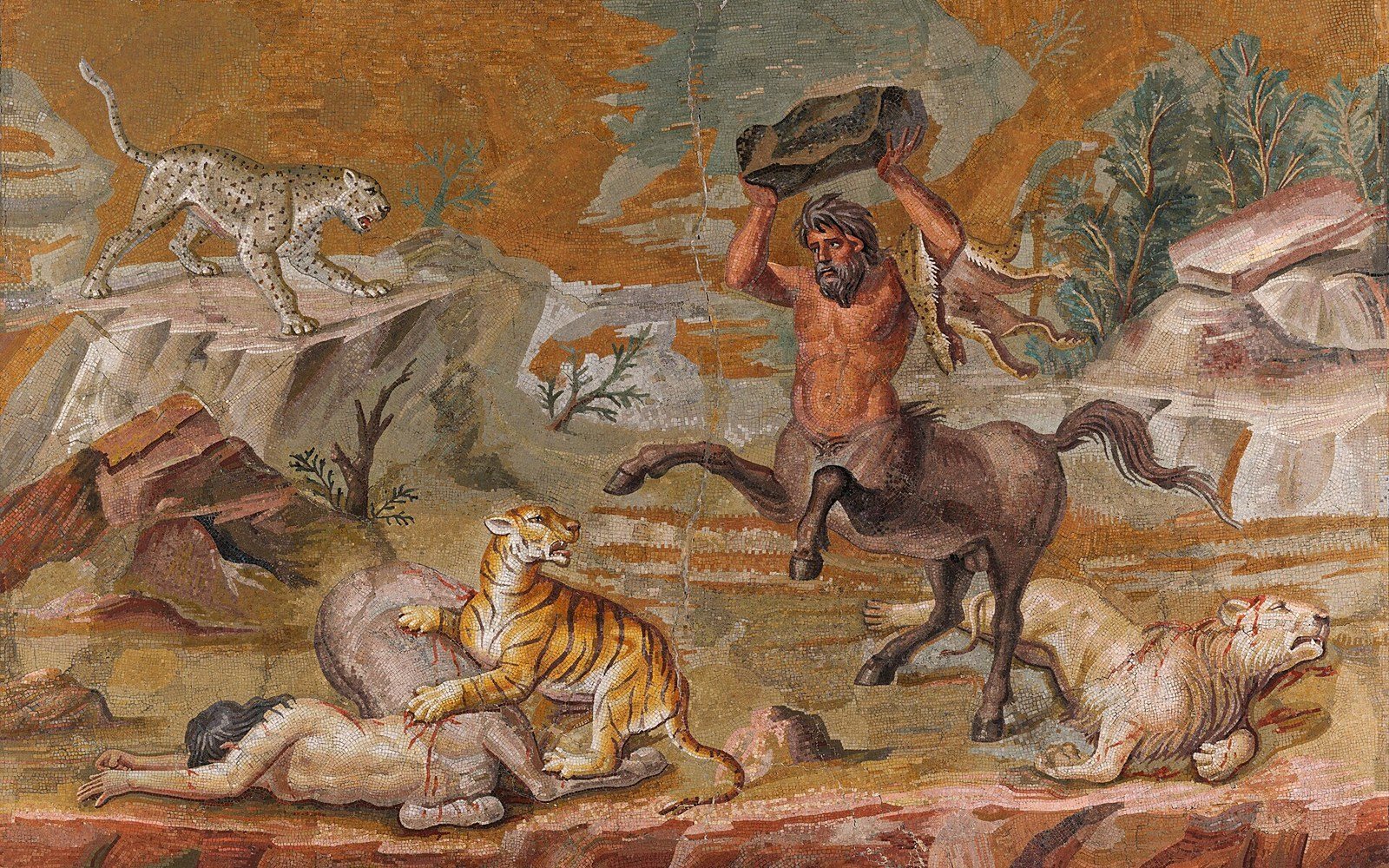
A building collapses inward. The roof falls first, then the walls, and the rubble beds down over centuries into a compacted layer that crushes almost everything at head height and above. The floor, already at ground level, is pushed down rather than broken apart. A mosaic — thousands of small stone or glass cubes, tesserae, set in a lime mortar bed — survives this compression better than plaster, timber or fired brick. Excavators at Butrint and at Apollonia have both found mosaic panels in reasonable condition beneath collapse deposits that obliterated the superstructure entirely.
That survivability is partly why mosaics became the prestige flooring of the ancient world in the first place. Owners understood they were making something that would outlast them. The investment was deliberate and legible: a mosaic floor announced rank, taste and money, and it announced them to every person who walked into the room.
- tesserae
- the individual cubes of stone, ceramic or glass that make up a mosaic
- opus signinum
- utilitarian flooring of crushed tile set in lime mortar, often with sparse geometric tesserae
- meander
- a continuous angular key-pattern border common in Hellenistic and early Roman mosaics
- cipollino
- a green-veined marble quarried on Euboea and widely traded across the Roman world
- kantharos
- a two-handled drinking cup, common as a decorative motif in vine-scroll borders
02Reading the floor
The vocabulary of a mosaic tells you which room you are in and how it was used. A simple opus signinum — crushed tile mixed into red mortar, sometimes with a scatter of white tesserae in a geometric pattern — marks a utilitarian or secondary space. A black-and-white geometric border around a figured central panel marks a reception room. A full polychrome scene, mythological or hunting, marks the principal dining or audience chamber, the room where a householder received guests whose opinion mattered.
Border patterns sharpen the reading further. A meander border signals Hellenistic taste; vine-scroll and kantharos motifs arrive with Roman provincial prosperity. By the second and third centuries, workshops across the Adriatic world were producing recognisable regional variants, and a trained eye can narrow the likely origin of a craftsman by the way he turned a corner or shaded a face.
Glass tesserae, which hold colour more purely than stone, are reserved for details: an eye, a highlight, a god's attribute.
The material itself is graded. Local limestone, easily cut, fills the field. Rarer coloured stones — imported green cipollino, Egyptian porphyry in high-status fragments — mark the centre. Glass tesserae, which hold colour more purely than stone, are reserved for details: an eye, a highlight, a god's attribute. Each material choice was a decision about expense, and expense was on public display every time the door opened.
What a mosaic floor cannot tell you is who actually lived above it. It names an economic level and a cultural aspiration, not a person. At sites where the archive is lost — which is most sites along this coast — the floor is frequently the most articulate witness that remains.
- Geometric black-and-whiteRepublican and early Imperial period
- Polychrome figured panelssecond–third century CE peak in provincial use
- Vine-scroll and kantharos motifsRoman provincial prosperity marker
- Glass tesserae used for detailspresent from Hellenistic period onward, not a precise date marker