The Durrës amphitheatre
Built into a hillside and recovered from beneath a city, it is one of the largest Roman structures in the Balkans — and it has a chapel inside it.
- Entry
- B.3
- Where
- Durrës, the old town
- Period
- Roman, later Byzantine
- Section
- The Ancient Shore
01A Roman amphitheatre, then a Christian room, then a street
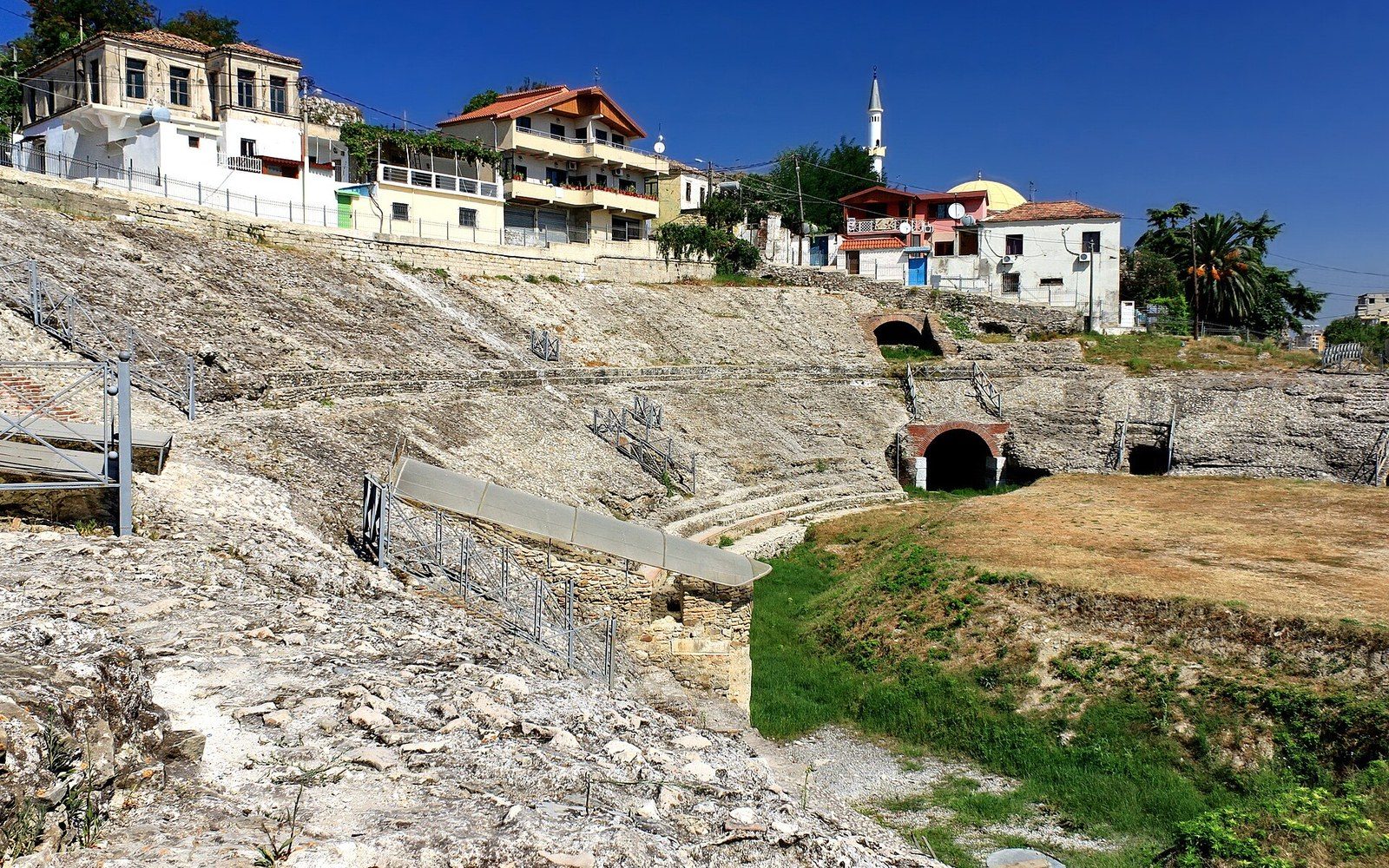
Durrës occupies the site of Epidamnos, a Greek colonial foundation of the seventh century BC, refounded as the Roman colony of Dyrrachium and eventually promoted to the capital of the province of Macedonia. Traffic on the Via Egnatia began here, at the Adriatic shore. The amphitheatre fits that scale: built probably in the first or second century AD, its outer circumference is among the largest of any such structure in the Balkans, with estimates placing original capacity somewhere in the range of fifteen to twenty thousand spectators.
The structure was cut directly into the flank of the low hill that anchors the old city — standard Roman engineering where terrain permits, since the hillside does the work that free-standing masonry would otherwise have to do. The seating tiers rode the natural slope; the arena floor sat at the hill's base. What survives is partial and uneven: centuries of building over, around and through it compressed the fabric into the ground, so that the amphitheatre's real extent only became clear during twentieth-century excavations, when the outlines emerged beneath a neighbourhood of modern streets and houses.
The mosaics are badly damaged, but the outlines of saints and at least one donor figure remain legible.
The most arresting feature is not the masonry vaulting or the arena wall but a small chapel inserted into one of the internal chambers, likely in the early Byzantine period. Its walls retain fragments of mosaic — figures in the manner of fifth- or sixth-century devotional art, rare enough in the region that their survival inside a repurposed pagan structure makes this chamber one of the more unusual interiors on the Albanian coast. The mosaics are badly damaged, but the outlines of saints and at least one donor figure remain legible.
Excavation is unfinished by nature here: the amphitheatre underlies a functioning district, and work has always been constrained by what lies above. The visible site is a partial exposure — vaulted corridors, sections of the arena perimeter, the chapel — set among apartment buildings on the edge of the old centre. What is exposed is conserved in place; a great deal more almost certainly remains under the street grid.
- 7th century BCGreek foundation of Epidamnos
- Roman periodrefounded as Dyrrachium, provincial capital of Macedonia
- 1st–2nd century ADamphitheatre constructed, cut into the hillside
- 5th–6th century ADchapel inserted into an internal chamber, mosaics applied
- 20th centurysystematic excavations reveal the full scale of the buried structure
- Capacity
- estimated 15,000–20,000 spectators
- Outer circumference
- among the largest amphitheatre footprints in the Balkans
- Current exposure: partial
- significant portions remain beneath active streets and buildings